


Prototyping and Label Testing
Prototyping and Label Testing
IML labels are designed to provide high quality graphics on fnished products, in a cost effective method. The materials
used will affect the ability to use the label in an IML application. Any conductive properties in producing the label, will
reduce the pinning strength of the mould tool through the label. It can also allow the charge generated on the label to
fow across the surface to earth.
Metallised plastics or conductive inks stop or reduce the pinning effect of the label to the mould tool. This results in
label slippage or the label not holding to the mould tool completely.
Surface resistance meters can only provide readings relating to the label face. It cannot provide information about
material buried below the face coating.
SOLUTION
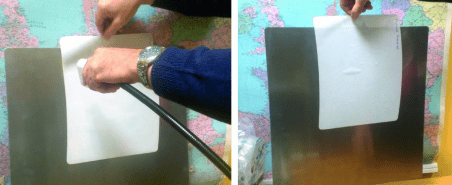
The most reliable method of testing the label is to generate a charge on the label while against an earthed plate.
Pictured in Fig.1 a sample label is charged against an aluminium sheet weighing 800g. in Fig.2 the aluminium sheet is
suspended using only the applied static charge.
If the label sparks or slips after the charging process has fnished, it will not be suitable for IML applications.
This test can be carried out using a Meech Hyperion 994CG-Compact Generator and 995R Handheld IML Pinning Head.
This test equipment is also suitable for:-
- Batch testing stocks of labels to ensure suitability for use in IML applications before putting into stock for later
use. - Manual prototyping of IML products prior to production automation. Small batch sample production for marketing.
- Related Products
Related Products
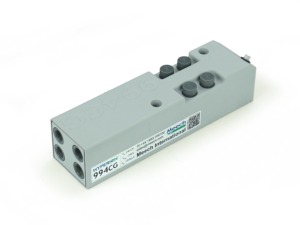 Hyperion 994CG – Compact Generator
Product Code: A994CG
The 994CG is designed for the IML market to meet the demand for a compact, lightweight generator to fit on the end of a robot arm.
 995R Handheld IML Pinning Head
Product Code: 995R-IML
The 995R-IML Manual Pinning Head is ideal for the manual application of charge, especially for In Mould Labelling applications.